Each State and Territory has a unique regulatory framework and it is not feasible for us to go into specific detail here. There are also more than 500 local government areas across Australia and each of them has their own unique set of regulatory provisions as well!
- Planning Policies
- Local Laws
- Plumbing and Building Regulations
Whether you
The Tiny House Approval Flow Chart provides an overview of common tiny house occupancy scenarios. The first question on that chart is “do you own the land?” As a land owner, you can make applications to and apply for permits from your local government. If you don’t own the land, then you will need the owner’s consent to make applications or apply for permits.
General enquiries about a land parcel can be made by anybody, so you can find out about planning policies, applicable overlays, local laws and other regulations without needing the landowner’s consent.
“The right zoning balances productive use and protection of neighbours and sensitive environments.”
Intensive use zones such as those for industry need to be buffered from residential zones and sensitive environments. Productive rural land will often have policies that limit the extent of buildings on a property.
Residential zones include a range of allowable densities - from high-density apartments to low-density detached houses and rural-residential land. Non-residential zones generally cannot contain dwellings, except in specific cases.
When looking at land options, first check the local government website for planning and development information where you can search by street address or property description. You will also encounter overlays (flooding, bushfire, heritage, biodiversity) that supplement zoning and help manage risks.
Some councils are complaint-driven—if a complaint establishes legal non-compliance (for example, more dwelling units than allowed), Council must act to enforce the law.
“Overlays like flooding or bushfire can change what is allowed on the same piece of land.”
“Development” has a specific meaning in planning schemes and there will be subtle differences from location to location, but the general meaning is anything that changes the landform or land use is development.
All development will trigger planning assessment, but some development is “self-assessable” or “as of right”.
Fencing, clothes lines and small garden structures are examples of development that typically does not require making an application or notifying Council. In such cases, it is up to you to understand the rules and make sure that you comply.
All other development will typically trigger an additional level of compliance assessment. This may simply mean lodging a form with Council or obtaining sign-off from a Building Certifier. The general rule is, the higher the potential impact, the more complex (and costly) a development application becomes. A proposal for multiple dwellings or a tiny house community will be more complex to prepare and assess than that for a single dwelling for example.
The law currently only requires the trailer to comply with Australian Standards and Codes. Anything added onto that trailer (the load) just needs to remain with the weight and dimensional requirements of VSB1, nothing more.
If you are trying to get a completed THOW assessed as a building, unless there has been a paper-trail with certificates issued by suitably qualified specialists covering the construction from the outset, it can be extremely difficult to demonstrate compliance with the BCA.
Building Code compliance is assessed by a Building Certifier. Some local government areas have building certifiers on staff, but there is also the (more common) possibility of using a Private Building Certifier that you appoint to assess your building permit application.
If you are thinking to DIY your build, then it will be essential to complete an Owner Builder’s course to understand what needs to be done to generate the paper trail required for building approval.
Also do some tiny house specific training such as offered by ATHA members and long-standing tiny house advocate, Fred’s Tiny Houses, or the like. You will not learn about building onto a trailer in a conventional owner-builder course!
Our March 2024 newsletter included discussion about what is involved in obtaining building approval and some of the challenges facing tiny houses on wheels.
Check out our Tiny House Buyer’s Guide for other things to consider before signing a contract.
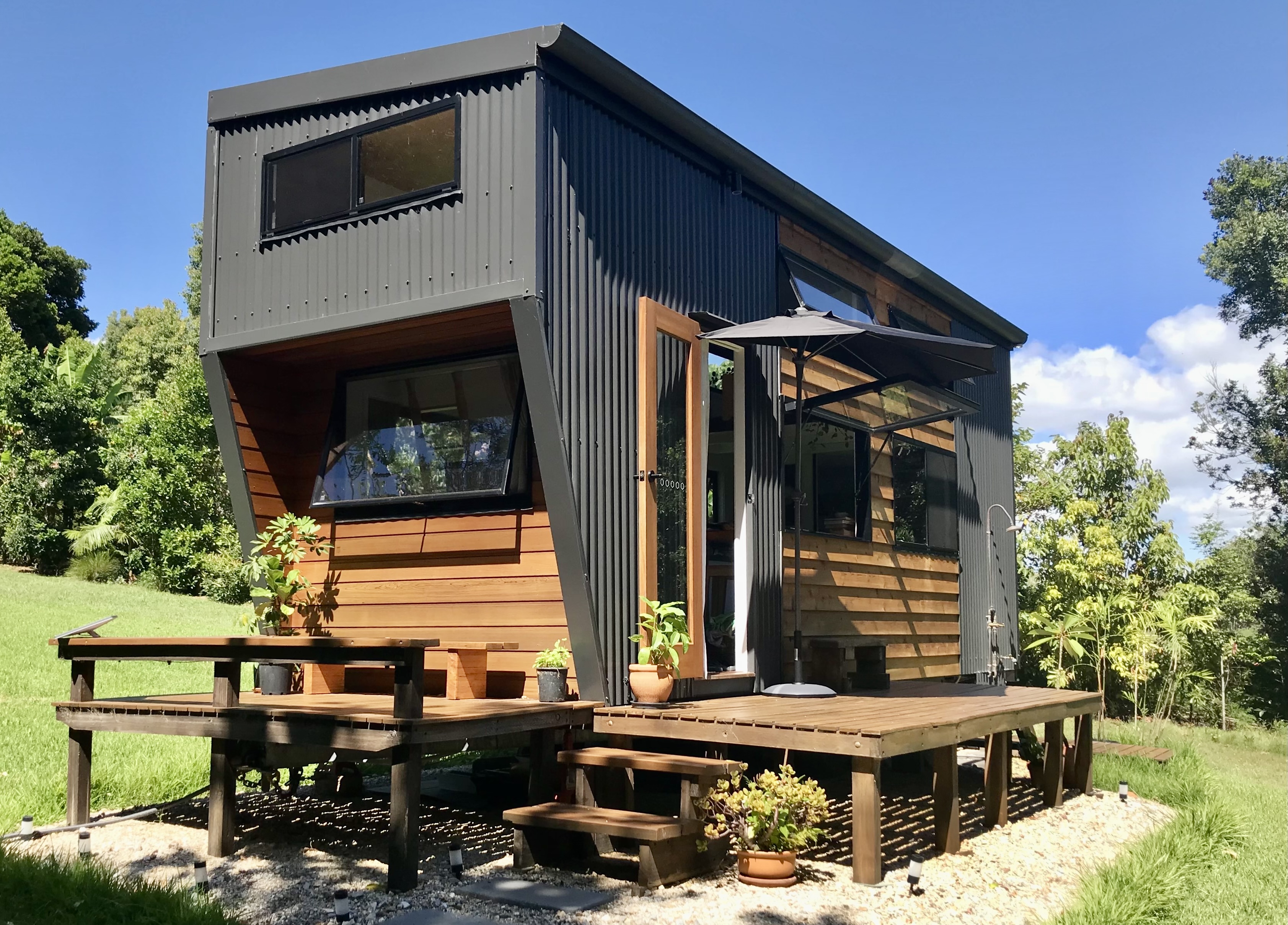
A tiny house may be deemed to be a dwelling unit for planning purposes, and as such, it may require a formal application to Council to demonstrate how the proposed use complies with relevant planning policies and codes.
A tiny house may pass as a caravan, in which case it is not subject to planning or building assessment, but Local Laws and the like will still apply. Tiny house dwellers are sometimes under the impression that because their THOW is a caravan “no approvals are required.” Whilst this may be technically correct, it does not always mean that it is possible to live permanently in your THOW on your own land or somebody else’s, or to connect it to a services infrastructure.
NSW currently has fairly liberal rules about living in a caravan, but these are under review and it seems likely that the outcome will have greater restrictions on THOWs. The official wording is “to provide clarity” but that doesn’t necessarily mean making it easier. For more information and to make a submission to the NSW Government planning framework review for caravan parks, camping grounds, manufactured home estates and moveable dwellings see: https://www.planning.nsw.gov.au/policy-and-legislation/housing/housing-sepp/caravan-parks-manufactured-home-estates-and-moveable-dwellings
Some caravan parks will accept THOW on a long-term basis, like a park cabin or permanent on-site caravan. This is currently the most certain opportunity for living permanently in a THOW, but not everyone wants to live in such a situation. Tiny House Villages or Communities are potentially a variation on the concept of a caravan park.
Property in a rural area may have the option to install worker’s accommodation or similar additional dwelling units “as of right” without further assessment. Traditionally this was intended for seasonal workers, or multi-generational families. More recently we have seen the advent of farm-stay and/or bed and breakfast style accommodation as a means for farm owners to diversify their income stream. Depending upon the intended use and local government policies, multiple dwelling units for un-related people on a working farm may be a possibility.
There is also “Rural Residential” land which has the character of a hobby farm or an acreage block that is typically too small to generate a primary production income but is substantially larger than a suburban house block. This category of land zoning is typically not granted the same flexibility with accommodation options as a full working farm. Please be aware it is this type of land zoning upon which some tiny home eviction situations have been reported.
Alternative pathways typically include some risk of being forced to move on, but in many cases, they are currently the only feasible option for people unable to obtain a building permit for their THOW.
We hope that you have found this information useful. There is still a long way to go before living in a moveable tiny house is an option for all who choose it. ATHA continues to take the call to government, but we are just a handful of volunteers and Australia is a big country, so please, help us to help you by making personal contact with your local elected representative to ensure that they know tiny houses are an option that a great many people are interested in.
Point out the Shire of Esperance in WA as the first local government area in Australia to welcome tiny house living. Ravensthorpe and Capel Shires, also in WA, have since followed suit and others are actively exploring options. The Surf Coast Shire in Victoria is currently conducting a tiny house trial. Shellharbour in NSW recently announced plans for a trial.
Thanks to our members for your ongoing support. If you are reading this as a subscriber, please consider becoming an ATHA member because we rely on solely membership revenue to cover our operating costs.